
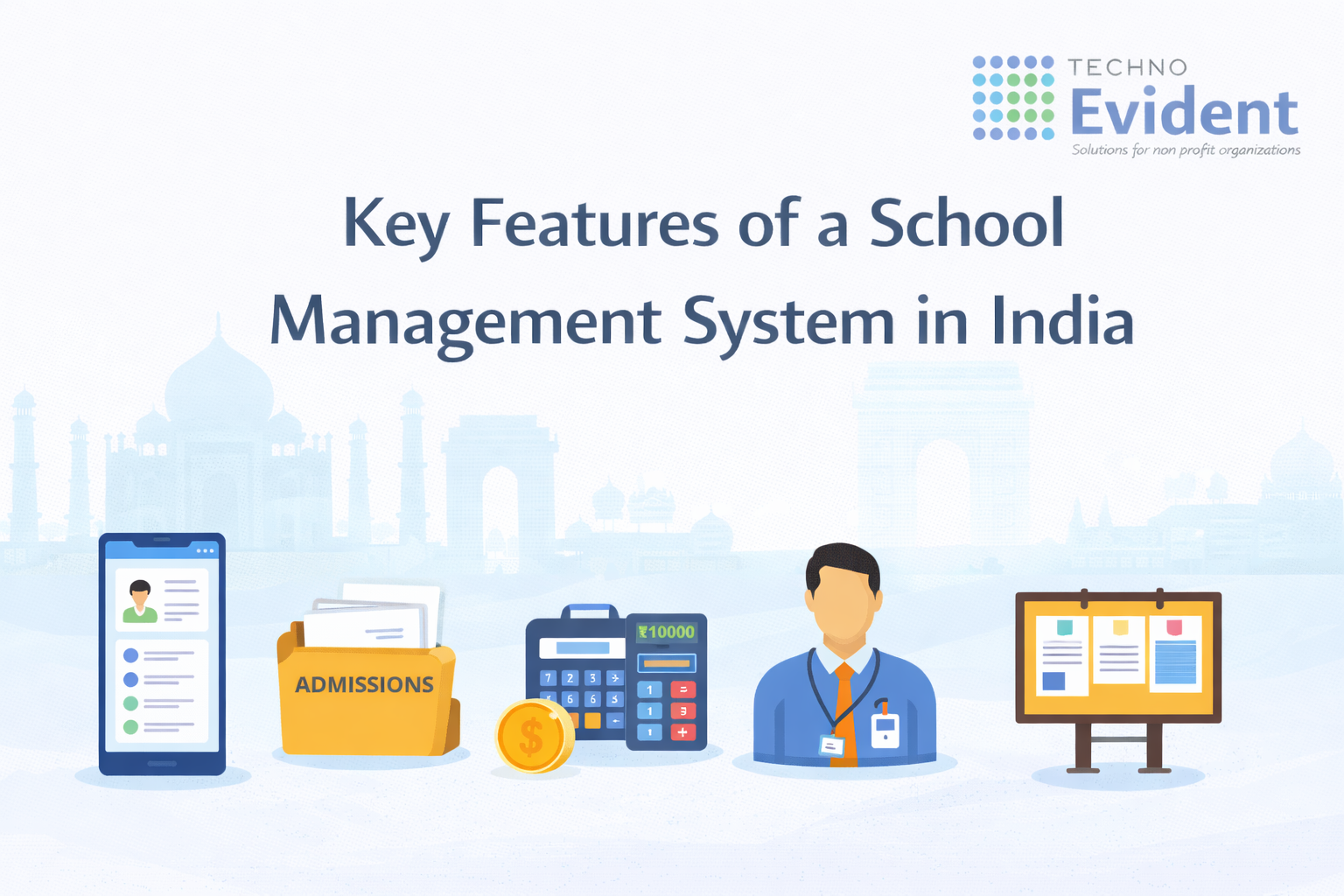

Indian schools today manage far more than classrooms and examinations. From admissions and attendance to fee collection, staff coordination, reporting, and parent communication, school administration has become increasingly complex.
Manual registers, spreadsheets, and disconnected tools make it difficult to operate efficiently at scale.
This is why schools across India are adopting a School Management System—a structured digital platform that helps schools manage academic and administrative operations from a single place.
In this article, we explore the key features of a School Management System in India, with a practical focus on how solutions like EdSof by TechnoEvident are designed around real school workflows.
Why Indian Schools Need a Feature-Focused School Management System
Before looking at individual features, it’s important to understand what Indian schools actually need.
A good School Management System in India should:
- Be easy for teachers and administrative staff to use
- Support Indian admission cycles and fee structures
- Reduce paperwork instead of adding complexity
- Improve transparency with parents and management
- Work reliably without heavy IT infrastructure
- Scale as the school grows
EdSof follows this practical approach by focusing on essential features that schools use daily, rather than unnecessary or overly complex modules.
Core Features of a School Management System
EdSof follows this practical approach by focusing on essential features that schools use daily, rather than unnecessary or overly complex modules.
1. Student and Guardian Management
A core feature of any School Management System is centralized student data.
With student and guardian management, schools can:
- Maintain complete student profiles
- Store guardian or parent contact details
- Access academic and administrative information easily
- Avoid duplication and data inconsistencies
EdSof enables schools to manage student and guardian records securely from one system, ensuring accurate information across departments.
2. Admission and Enrollment Management
Admissions are one of the most demanding processes for Indian schools, especially during the academic intake period.
A School Management System simplifies enrollment by:
- Digitally recording student admissions
- Organising students by class and section
- Reducing paperwork and manual follow-ups
- Maintaining structured admission records year after year
EdSof’s enrollment management helps schools handle admissions in an organised and scalable way without disrupting existing processes.
3. Attendance Management System
Manual attendance tracking is time-consuming and prone to errors.
With a digital attendance management system, schools can:
- Record daily attendance efficiently
- Track attendance class-wise or section-wise
- Generate attendance reports for review
- Support academic monitoring and discipline
EdSof provides structured attendance tracking that reduces workload for teachers and improves accuracy.
4. Fee and Accounts Management
Fee management is a critical area for Indian schools, where transparency and accuracy are essential.
A School Management System supports fee and accounts management by:
- Organising fee structures clearly
- Tracking fee collections and pending dues
- Generating receipts and vouchers
- Maintaining clear financial records
EdSof integrates fee tracking with accounts management, helping schools maintain better financial control and accountability.
5. Examination and Report Management
Preparing exams and report cards manually requires significant time and effort.
A School Management System helps schools:
- Manage examination data centrally
- Record academic performance
- Generate student report cards
- Maintain combined academic reports
EdSof supports examination records and reporting, enabling schools to streamline academic evaluation and reduce manual work.
6. Employee and Faculty Management
Schools are organisations that rely heavily on teachers and staff.
With employee and faculty management, schools can:
- Maintain staff and faculty records
- Assign roles and responsibilities
- Improve internal coordination
- Reduce dependence on manual HR tracking
EdSof provides structured staff management to support smooth daily operations.
7. Tasks and Events Management
School administration involves continuous coordination of tasks and events.
A School Management System allows schools to:
- Assign and track internal tasks
- Plan and manage school events
- Maintain clarity across departments
- Improve accountability
EdSof includes task and event management features to help schools stay organised throughout the academic year.
8. Parent–School Communication
Clear and consistent communication builds trust with parents.
A School Management System improves communication by:
- Centralising notices and announcements
- Sharing student updates through a structured system
- Reducing confusion caused by multiple communication channels
EdSof enables organised communication between schools, teachers, students, and guardians.
9. Student Diary and Updates
A digital student diary helps schools:
- Share academic instructions and updates
- Communicate important notices
- Keep parents informed of school activities
- Maintain a clear record of communication
This feature improves parent engagement while reducing misunderstandings.
10. Reports, Data Control, and Backup
Data-driven decision-making is becoming increasingly important for Indian school leadership.
A School Management System provides:
- Attendance and enrollment reports
- Fee and financial summaries
- Academic performance insights
- Exportable data for review
- In addition, secure data storage and regular backups ensure:
- Protection of sensitive student and staff information
- Continuity in case of technical issues
- Compliance with institutional record-keeping requirements
- EdSof includes complete data backup mechanisms to safeguard school data.
11. Cloud-Based School Management System Advantages
Most modern School Management Systems in India are cloud-based.
This allows schools to:
- Access data securely from anywhere
- Avoid maintaining in-house servers
- Receive system updates automatically
- Reduce long-term IT costs
EdSof is designed as a cloud-ready solution, making it suitable for schools seeking flexibility without technical complexity.
How EdSof Brings These Features Together
Rather than overwhelming schools with unnecessary options, EdSof focuses on:
- Student and guardian management
- Admissions and enrollment
- Attendance tracking
- Fees and accounts
- Staff coordination
- Tasks, events, and reporting
This integrated approach helps Indian schools digitize administration while maintaining familiar workflows.
How to Evaluate School Management System Features Before Choosing
Before selecting a School Management System, Indian schools should consider:
- Ease of use for teachers and administrators
- Availability of essential features
- Data security and backup
- Scalability for future growth
- Reliability of support
Choosing a feature-focused system ensures long-term efficiency and adoption.
Conclusion
The key features of a School Management System in India are designed to address real administrative and academic challenges faced by schools.
A well-implemented system:
- Reduces manual work
- Improves accuracy and transparency
- Enhances communication with parents
- Supports better academic and administrative control
Solutions like EdSof by TechnoEvident provide Indian schools with a practical, structured platform to manage operations efficiently without unnecessary complexity.

0 Comments